



Table of Contents
ToggleA cramped living room doesn’t have to feel like a cave. Poor lighting makes small spaces shrink even further, creating dark corners and visual clutter. The right lighting strategy can open up square footage, define zones, and make a 10×12 room feel twice its size. This guide walks through fifteen practical lighting techniques, from fixture selection to strategic placement, that actually work in compact spaces. No fluffy mood boards. Just proven methods, fixture specs, and installation tips that transform dim rooms into bright, functional living areas.
Key Takeaways
- Small living room lighting ideas work best when layered into ambient, task, and accent light sources rather than relying on a single overhead fixture.
- Corner uplights and wall sconces at mid-height eliminate dark zones and make compact spaces feel larger and more open.
- Use warm color temperature (2700K–3000K) for ambient lighting and neutral white (3500K–4000K) for task areas to create cohesive, comfortable spaces.
- Aim for 1,500–2,000 total lumens in a small living room spread across multiple fixtures to avoid harsh shadows and visual clutter.
- Strategic placement above furniture and along traffic paths, rather than center-ceiling mounting, prevents shadows and maximizes the perceived size of compact rooms.
- Budget-friendly plug-in solutions like LED strips, track lighting kits, and smart bulbs deliver professional small living room lighting results without hardwiring.
Why Lighting Matters in Small Living Rooms
Light affects spatial perception more than paint color or furniture arrangement. A poorly lit small room feels cramped, while proper illumination creates visual depth and openness.
Vertical space becomes usable when wall sconces or uplights draw the eye upward. Dark ceilings make rooms feel lower: bouncing light off a white ceiling adds perceived height. In rooms with 8-foot ceilings, this trick matters.
Shadows in corners create visual boundaries that shrink a room. Eliminating dead zones with multiple light sources, rather than one harsh overhead fixture, makes the perimeter disappear. The room reads as continuous space instead of a series of dark pockets.
Task-specific lighting reduces clutter. A reading lamp replaces the need for brighter overhead lights when someone’s watching TV. Dimmable fixtures let one room serve multiple functions without feeling too bright or too dark for any activity.
Building codes typically require one switched light per habitable room (IRC R303.8), but code minimums don’t create comfortable spaces. Small rooms need more intentional lighting design than large ones because there’s less margin for error.
Layer Your Lighting for Maximum Impact
Three-layer lighting, ambient, task, and accent, turns a one-dimensional room into a flexible space. Each layer serves a purpose.
Ambient lighting provides general illumination. In small living rooms, this usually means:
- Flush-mount or semi-flush ceiling fixtures (8–12 inches tall) that don’t hang down and steal headroom
- Recessed cans spaced 4–6 feet apart for even coverage without visual clutter
- Track lighting aimed at walls to bounce light and avoid harsh downlighting
Skip oversized chandeliers. They overwhelm small rooms and create glare at eye level.
Task lighting focuses on specific activities. Position these where people actually sit or work:
- Floor lamps behind sofas for reading, with adjustable heads or three-way bulbs (50/100/150W equivalent)
- Swing-arm wall sconces beside seating, mounted 40–48 inches from the floor to the center of the fixture
- Table lamps on end tables, 58–64 inches tall total (lamp plus table height) to align with seated eye level
Designers at Apartment Therapy frequently recommend using task lighting to create functional zones in multipurpose rooms.
Accent lighting adds depth and highlights architectural features:
- LED strip lights behind floating shelves or under media consoles
- Picture lights or small spot lighting on artwork to create focal points
- Uplights in corners to wash walls and make the room feel taller
Dimmer switches (compatible with LED bulbs, check product specs) let each layer adjust independently. A Lutron Diva or similar dimmer costs $15–$30 and installs in 15 minutes with basic wiring knowledge.
Strategic Placement: Where to Position Lights in Compact Spaces
Corner uplights eliminate the darkest areas. A torchiere-style floor lamp or a small LED uplight ($20–$60) bounces light off walls and ceilings, making corners disappear. Place one in at least one corner, two opposite corners if the room’s under 150 square feet.
Over furniture, not between pieces. Overhead lights centered in the room often land between furniture groupings, creating shadows on faces. Position recessed lights or track heads above seating areas and along traffic paths instead of dead center.
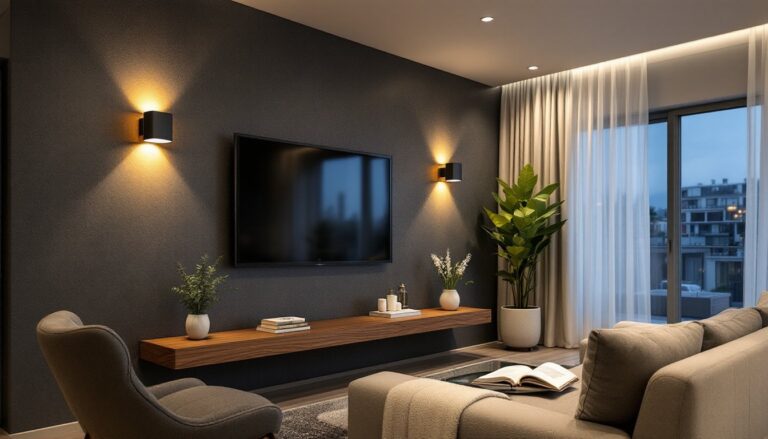
Wall sconces at mid-height free up floor and table space. Mount them 60–66 inches from the floor in living areas (lower than bedroom or hallway sconces). Hardwiring requires cutting into drywall and running cable, but plug-in sconces with cord covers offer an easier alternative. Examples from Homedit show that modern minimalist lighting design uses fewer fixtures placed more deliberately.
Behind the TV or media console, LED bias lighting reduces eye strain and makes screens appear larger. Stick-on LED strips (12V, SMD5050 or SMD2835 chips) mount in minutes. Aim for 6500K color temperature behind screens: warmer tones look orange by comparison.
Avoid center-only lighting. One ceiling fixture in the middle of a small room creates a hot spot with dark perimeter. If that’s the only electrical box available, supplement with plug-in floor or table lamps on opposite walls. Aim for at least three light sources total in rooms under 200 square feet.
Best Light Fixtures for Small Living Rooms
Recessed LED downlights (4-inch or 6-inch cans) provide ambient light without visual bulk. Choose IC-rated housings if they’ll contact insulation in the ceiling. Retrofit LED kits ($10–$25 each) screw into existing sockets if cans are already installed. New construction? Install sloped-ceiling housings in vaulted areas to keep the trim flush.
Track lighting offers flexibility. Single-circuit tracks work fine: multi-circuit tracks (with two separate switches) let you control different heads independently. Choose low-profile tracks (under 1 inch deep) and aim heads at walls, not down at people. House Beautiful often features galleries showing how lighting systems can redefine room ambiance.
Flush-mount ceiling fixtures (10–16 inches diameter for small rooms) work where hanging pendants would obstruct sight lines. Look for fixtures with diffusers, frosted glass or fabric, rather than exposed bulbs to prevent glare.
Slim floor lamps (tripod, arc, or pole styles) take up less visual space than traditional shaded lamps. Arc lamps ($80–$300) reach over sofas without needing a side table. Ensure the base weighs at least 15 pounds to prevent tipping.
LED panel lights mount flush and provide even, shadow-free illumination. LED panel lights work well in modern spaces where a seamless ceiling look matters. Standard sizes: 1×4 feet, 2×2 feet, or 2×4 feet. A 2×2 panel typically outputs 3000–4000 lumens, equivalent to a 200W incandescent.
Wall-mounted swing-arm lamps eliminate the need for end tables. Hardwired versions require an electrical box and wall switch: plug-in types need an outlet within 3 feet. Brands like Ikea’s Ranarp or similar industrial styles ($30–$80) offer adjustability without bulk.
Avoid: Oversized drum pendants, multi-tier chandeliers, or anything hanging below 7 feet in rooms with 8-foot ceilings. They create head-bump hazards and visual clutter.
Color Temperature and Bulb Selection Tips
Color temperature (measured in Kelvin) changes how a room feels. Small spaces benefit from 2700K–3000K (warm white) for ambient and accent lighting. It mimics incandescent bulbs and makes spaces feel cozy without the yellow tint of old 2400K bulbs.
Use 3500K–4000K (neutral white) for task lighting where color accuracy matters, reading, hobbies, or detail work. It’s bright enough to reduce eye strain without the cold, clinical feel of 5000K+ bulbs.
Avoid mixing color temperatures in the same room. A 2700K floor lamp next to a 5000K recessed light looks disjointed. Stick within a 500K range across all fixtures.
Lumens over watts. A small living room (100–150 sq ft) needs roughly 1,500–2,000 lumens total for ambient lighting. Divide that across multiple fixtures, four recessed lights at 400–500 lumens each, for example. For task lighting, add 300–500 lumens per reading area.
CRI (Color Rendering Index) affects how accurately colors appear. Look for CRI 90+ in living spaces. Cheap LEDs (CRI 80) make skin tones look gray and furniture colors dull. The 5–10% price premium for higher CRI pays off in perceived quality.
Dimmable LEDs require compatible dimmers. Not all LEDs dim smoothly: some flicker or hum at low settings. Check packaging for “dimmable” labels and match to ELV (electronic low voltage) dimmers. Lutron, Leviton, and Legrand make reliable options ($18–$40).
Budget-Friendly DIY Lighting Solutions
Plug-in track lighting kits ($40–$80) mount to ceilings without hardwiring. The plug reaches an existing outlet: the track attaches with drywall anchors into ceiling joists or blocking. Use a stud finder to locate 16-inch on-center joists. Toggle bolts (rated for 50+ pounds) work in drywall where joists aren’t accessible.
LED strip lights transform dark corners and create indirect lighting. Kits ($15–$50 for 16 feet) include adhesive backing, a plug-in transformer, and sometimes a remote. Install behind crown molding, under shelves, or along baseboards. Cut strips only at marked copper pads, usually every 2–4 inches. Solder or use clip connectors to rejoin cut sections.
Clamp lamps ($8–$15) attach to shelves, headboards, or furniture edges. Swap the builder-grade clip-on shade for a more finished drum shade ($12–$25) to avoid the workshop look. Use LED bulbs to prevent heat damage to furniture.
Rope lights in crown molding create a floating ceiling effect. Install simple pine or MDF crown (3–4 inches tall, about $1–$2 per linear foot) 2–3 inches below the ceiling line. Run LED rope lights in the gap. Miter cuts at corners require a miter saw or miter box with a hand saw, don’t skip this step or joints won’t close.
IKEA hacks: The LACK shelf ($10) mounts in 10 minutes with included hardware. Add adhesive LED puck lights ($3–$5 each, battery or plug-in) underneath for instant accent lighting. The TERTIAL work lamp ($10) clamps anywhere and adjusts 360 degrees, cheap but effective task lighting.
Smart bulbs (Wyze, Philips Hue, LIFX) cost $8–$15 each and add dimming, color temperature control, and scheduling without replacing switches or fixtures. They require Wi-Fi and a phone app but no electrical work. Use them in existing lamps and ceiling fixtures for instant flexibility.
Safety note: Always use UL-listed products, especially for plug-in transformers and LED drivers. Cheap no-name electronics from overseas marketplaces have caused fires. Spend the extra $5 for known brands.
Conclusion
Small living rooms demand smarter lighting, not just more fixtures. Layering ambient, task, and accent light sources creates depth and flexibility that a single overhead fixture can’t deliver. Strategic placement, corners, behind furniture, mid-height on walls, eliminates dark zones and makes every square foot count. Stick to warm color temperatures, aim for 1,500–2,000 total lumens, and choose low-profile fixtures that don’t overwhelm the space. Whether hardwiring recessed cans or mounting plug-in track kits, the right approach turns a cramped room into a bright, functional space.