





Table of Contents
ToggleInstalling an outdoor motion sensor light isn’t just about convenience, it’s about security, energy savings, and making your property safer after dark. Whether you’re trying to deter would-be intruders, light up a dark driveway, or simply stop fumbling for keys at the front door, motion-activated exterior lighting does the heavy lifting for you. The technology’s gotten cheaper, brighter, and smarter over the past few years, and most homeowners can install a basic fixture in under an hour with common tools. This guide walks through everything from sensor types and placement strategy to wiring and troubleshooting, so you can pick the right fixture and get it working reliably.
Key Takeaways
- Outdoor motion sensor lights enhance security by deterring intruders while saving 70–90% energy compared to always-on fixtures, especially when using LED technology.
- The three main sensor types are PIR (detects body heat), microwave (detects through barriers), and dual-technology (combines both for fewer false alarms), each suited to different environments and budgets.
- Choose your outdoor motion sensor light based on detection range, lumen output (1,200+ for security), IP weather rating (IP65 minimum), and adjustable sensitivity to reduce false triggers from wildlife or heat sources.
- Installation typically takes under an hour for fixture replacement, but hardwired setups may require permits and an electrician, while solar or plug-in models offer permit-free alternatives.
- Fine-tuning sensor settings after installation—adjusting range, dwell time, and lux threshold—prevents false triggers from HVAC vents, tree movement, or extreme temperatures in your specific location.
What Is an Outdoor Motion Sensor Light and How Does It Work?
An outdoor motion sensor light combines a standard light fixture with a detector that triggers illumination when it senses movement. Most use one of three sensing technologies: passive infrared (PIR), microwave, or dual-technology sensors.
PIR sensors are the most common. They detect changes in infrared radiation, essentially body heat. When a person or animal crosses the detection zone, the temperature shift triggers the light. PIR works best in moderate climates and has minimal false triggers from wind-blown foliage.
Microwave sensors emit continuous microwave pulses and measure reflections. They’re more sensitive and can detect motion through barriers like glass or thin walls, but they also trigger more easily from non-human sources (vehicles, large animals, even heavy rain).
Dual-technology models combine PIR and microwave, requiring both sensors to confirm motion before activating. This cuts false alarms but costs more upfront.
Most fixtures let you adjust sensitivity (detection range), duration (how long the light stays on), and sometimes lux threshold (ambient light level below which the sensor activates). Typical detection ranges run 20 to 70 feet, and dwell times range from 30 seconds to 10 minutes.
Key Benefits of Installing Motion Sensor Lights Around Your Home
Security and deterrence. A sudden flood of light when someone approaches is one of the simplest and most effective deterrents. Intruders prefer dark, unobserved entry points: motion-activated exterior lighting eliminates that advantage. Even if you’re home, the light alerts you to activity before anyone reaches the door.
Energy savings. An exterior light with motion sensor only runs when needed, cutting runtime by 70–90% compared to dusk-to-dawn fixtures. If you’re using LED motion sensor outdoor lights, energy consumption drops even further, most draw 10 to 20 watts and last 25,000+ hours.
Safety and convenience. No more stumbling over garden hoses or misjudging porch steps in the dark. Motion sensor outdoor lights automatically illuminate walkways, stairs, and entry points, reducing trip hazards and making it easier to carry groceries or wrangle kids at night.
Low maintenance. Once installed and adjusted, motion detector lighting outdoor runs autonomously. LED bulbs rarely need replacement, and weatherproof housings (IP65 or higher) handle rain, snow, and UV exposure for years without intervention.
Types of Outdoor Motion Sensor Lights to Consider
Floodlights. These cast broad, high-lumen beams, typically 1,500 to 3,000 lumens per head. Dual-head or single-head configurations mount under eaves or on walls. Choose a motion sensor LED outdoor light floodlight for driveways, backyards, or any large area that needs quick, bright coverage. Look for adjustable heads so you can aim each lamp independently.
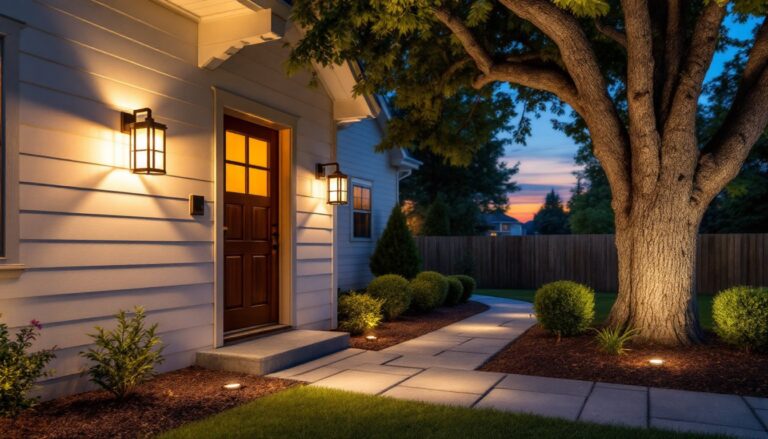
Wall-mounted lanterns and sconces. These blend security with curb appeal. Many traditional coach lights and modern box sconces now come with integrated PIR sensors. Output ranges from 800 to 1,500 lumens, enough for porches, garage side doors, and entryways. If aesthetics matter, this is your category.
Spotlights and bullet lights. Narrow-beam fixtures (15–30° beam angle) that highlight pathways, flag poles, or landscaping features. They’re also useful for covering long, narrow zones like side yards. Most are compact and unobtrusive.
Solar-powered models. These include a small photovoltaic panel, rechargeable battery, and LED array. No wiring required, but performance depends on sunlight exposure. Best for sheds, garden paths, or locations far from existing electrical boxes. Expect lower lumen output (300–800 lumens) and shorter runtime per trigger.
Smart motion lights. Wi-Fi–enabled fixtures integrate with home automation platforms (Alexa, Google Home, HomeKit). You can set schedules, adjust sensitivity remotely, and receive alerts when motion is detected. Some models include cameras. These require a nearby outlet or hardwired connection plus stable wireless signal.
How to Choose the Right Motion Sensor Light for Your Property
Detection range and coverage pattern. Measure the area you want to cover. A single-head floodlight typically covers a 180° arc out to 30–50 feet. For narrower side yards, a 110° beam may suffice. If you’re lighting a corner or wrap-around deck, consider dual-head fixtures or two separate units to eliminate blind spots. Independent testing from sources like professional reviewers can help identify models with reliable detection zones.
Lumen output and color temperature. For security, aim for at least 1,200 lumens: 2,000+ is better for large areas. Color temperature (measured in Kelvin) affects visibility and mood: 3000K is warm white (yellowish), 4000K is neutral, and 5000–6000K is daylight (bluish-white). Cooler temps improve contrast and visibility at a distance.
Power source. Hardwired fixtures (120V AC) offer unlimited runtime and higher brightness but require existing electrical boxes or new wiring, potentially a permit-level job under the National Electrical Code (NEC Article 110). Battery and solar models install anywhere but need periodic battery replacement or adequate sun. Plug-in units work if you have exterior GFCI outlets nearby.
Weather resistance. Look for an IP rating of at least IP65 (dust-tight, protected against water jets). If your location sees heavy snow or coastal salt spray, IP66 or IP67 is safer. Check that gaskets, lenses, and housings are UV-stabilized and won’t yellow or crack.
Adjustability. Quality fixtures let you tune sensitivity (to ignore small animals), dwell time (so lights don’t stay on wastefully), and lux threshold (so they don’t trigger in daylight). Some add a manual override or vacation mode.
Build quality and warranty. Die-cast aluminum or heavy-duty polycarbonate housings outlast thin stamped steel. A three-year warranty signals confidence in the electronics. Comparing hands-on tested models can reveal which brands hold up in real-world conditions.
Step-by-Step Installation Guide for Outdoor Motion Sensor Lights
Safety first. Turn off power at the breaker and verify with a non-contact voltage tester. Wear safety glasses and work gloves. If you’re working above shoulder height, use a stable ladder and have a second person spot you.
Tools and materials:
- Non-contact voltage tester
- Screwdriver (Phillips and flat-head)
- Wire strippers
- Wire nuts (typically 3-4 depending on fixture)
- Weatherproof sealant or foam gasket (often included)
- Drill and masonry bit (if mounting to brick or stucco)
- Ladder
Step 1: Remove the old fixture (if replacing). Unscrew the mounting plate, disconnect wire nuts, and pull the old fixture free. Inspect the electrical box: it should be securely fastened and rated for outdoor use (weatherproof box with a gasket or in-use cover).
Step 2: Attach the mounting bracket. Most outdoor lighting motion sensor fixtures include a round or rectangular bracket that screws directly to the box. Align the bracket holes with the box threads and drive in the provided machine screws. If mounting to a new location without an existing box, you’ll need to install a weatherproof junction box and run 14/2 or 12/2 NM-B cable (or UF-B for underground feed) from a nearby circuit. That’s permit territory in most jurisdictions, consult local code.
Step 3: Connect the wires. Outdoor fixtures typically have three leads: black (hot), white (neutral), and green or bare copper (ground). Match them to the corresponding house wires using wire nuts. Twist clockwise, tug to test, and wrap each nut with electrical tape for extra moisture protection. Tuck wires neatly into the box, don’t pinch them.
Step 4: Secure the fixture and seal. Slide the fixture onto the bracket and tighten the locking nuts or screws. Press the foam gasket between the fixture base and the wall to keep moisture out. For brick or stucco, apply a bead of silicone caulk around the top and sides (leave the bottom open for drainage).
Step 5: Install bulbs (if not integrated LED). Screw in the recommended wattage, never exceed the label rating. Integrated LED units skip this step.
Step 6: Adjust sensor settings. Most sensors have dials or DIP switches for range, time, and lux. Start with mid-range settings: 50% sensitivity, 1-minute timer, dusk-only activation. Turn the breaker back on.
Step 7: Test and fine-tune. Walk through the detection zone from several angles. If the light doesn’t trigger, increase sensitivity or reposition the sensor head (many pivot on a ball joint). If it triggers too often, dial back sensitivity or aim the sensor away from heat sources (dryer vents, AC condensers, car exhaust). According to expert testers, fine-tuning can take a few days of real-world observation.
Permit note: Replacing an existing fixture on the same circuit usually doesn’t require a permit. Running new circuits, adding junction boxes, or modifying service panels typically does. Check with your local building department.
Troubleshooting Common Motion Sensor Light Issues
Light stays on continuously. The sensor may be stuck in test or manual mode. Check for a small switch on the sensor housing. Also verify that the lux dial isn’t set to daytime operation. If the photocell is dirty or damaged, it may think it’s always dark.
Light never turns on. Confirm power at the breaker and test voltage at the fixture with a multimeter. Check that bulbs (if replaceable) are seated properly and not blown. Inspect wire connections inside the box, loose neutrals are a common culprit. If the sensor lens is cracked or fogged with condensation, replace the unit.
Frequent false triggers. PIR sensors can be fooled by heat sources: HVAC vents, hot pavement cooling at dusk, or even sun reflecting off windows. Reposition the sensor or lower sensitivity. Trim back tree branches and tall grass that sway into the detection zone. In areas with lots of wildlife, consider a dual-tech sensor or pet-immune mode (if available).
Short bulb life (non-LED). Vibration from slamming doors, frequent on-off cycles, or voltage spikes can shorten incandescent and CFL bulbs. Switch to LED bulbs rated for enclosed fixtures and outdoor use. They handle cycling better and tolerate temperature swings.
Erratic operation after a storm. Moisture intrusion is the usual suspect. Remove the fixture, inspect wire nuts and connections, and re-seal with fresh silicone. If water pooled inside the housing, let it dry thoroughly before reinstalling. Replace the gasket if it’s compressed or torn.
Conclusion
Outdoor motion sensor lights deliver security, efficiency, and convenience with minimal upkeep. Whether you’re upgrading a single porch fixture or outfitting an entire perimeter, choosing the right sensor type, lumen output, and mounting location makes all the difference. Most installs are straightforward, swap an old fixture in under an hour, but don’t skip the fine-tuning phase or the weatherproofing details. A well-adjusted motion sensor light outdoor setup pays dividends every time you pull into the driveway after dark or hear that reassuring click when a visitor approaches.