





Table of Contents
ToggleOutdoor lighting fixtures do more than light up a porch, they add curb appeal, improve security, and extend your usable space after dark. Whether someone’s installing a motion-sensor floodlight above the garage or lining a walkway with low-voltage path lights, the right fixture makes a difference in both function and aesthetics. In 2026, homeowners have access to smarter, more energy-efficient options than ever, from integrated LED fixtures to solar-powered designs that eliminate wiring headaches. This guide walks through fixture types, selection criteria, installation basics, and maintenance strategies so any DIYer can confidently light up their home’s exterior.
Key Takeaways
- Outdoor lighting fixtures enhance safety, security, and home value by illuminating walkways and entry points while reducing trip hazards and deterring intruders.
- Choose an outdoor lighting fixture based on location exposure (wet vs. damp), light output in lumens, color temperature (2700K for warm, 4000K+ for security), and power source—line-voltage, low-voltage, or solar.
- Wall-mounted sconces should be positioned 66–72 inches above the threshold, while pathway lights work best on low-voltage 12V systems with a transformer for reliable illumination beyond 100 feet.
- Always turn off power at the breaker, verify with a non-contact voltage tester, bury UF-B cable at least 12 inches deep, and use weatherproof junction boxes with silicone sealing to prevent water intrusion.
- Inspect fixtures every 3–6 months for loose hardware and water intrusion, clean lenses with mild soap, apply car wax to metal finishes, and trim vegetation to maintain airflow and prevent moisture buildup.
- Hire a licensed electrician for new circuits, panel upgrades, or complex switching, and consider professional help for structural mounting issues on brick or stone surfaces.
What Are Outdoor Lighting Fixtures and Why Do They Matter?
An outdoor lighting fixture is any luminaire designed to withstand weather exposure, rain, UV, temperature swings, and humidity. Unlike interior fixtures, outdoor models carry an IP (Ingress Protection) rating that indicates their resistance to dust and moisture. A fixture rated IP65, for example, is dust-tight and can handle low-pressure water jets, making it suitable for covered patios. An IP67 fixture can survive brief submersion, ideal for ground-level installations near sprinklers.
These fixtures serve three overlapping purposes. First, safety and security: well-lit walkways reduce trip hazards, and illuminated entry points deter intruders. Second, functionality: task lighting over an outdoor kitchen or deck steps extends how the space is used. Third, aesthetics: accent lighting on architectural features or landscape elements adds depth and visual interest after sunset.
Proper outdoor lighting also impacts home value. According to real estate professionals, thoughtful exterior lighting ranks high on buyer wish lists, especially when it highlights landscaping or creates a welcoming entry. But poorly chosen fixtures, overlapping glare zones, mismatched color temperatures, or corroded hardware, can detract from a home’s appearance and even create liability issues if they fail to illuminate hazards.
Types of Outdoor Lighting Fixtures for Every Outdoor Space
Wall-Mounted Fixtures and Sconces
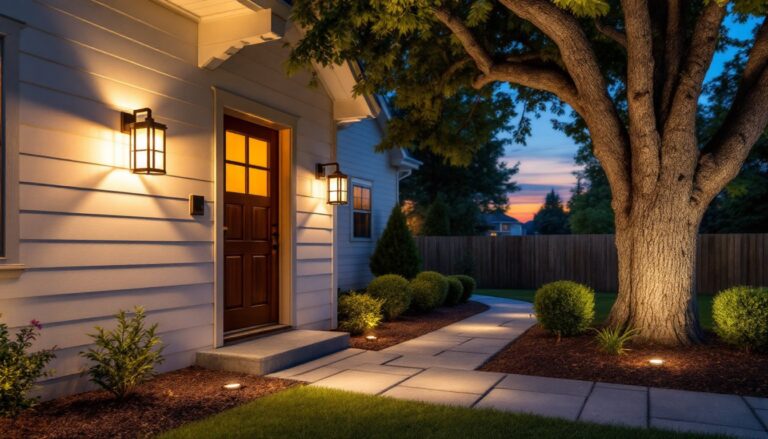
Wall-mounted fixtures and sconces are the workhorses of exterior lighting, installed beside entry doors, garage doors, or anywhere a vertical surface meets a need for light. Most mount to a standard 4-inch round or rectangular junction box: make sure the box is rated for wet or damp locations depending on exposure.
Choose down-facing sconces to minimize light pollution and glare, upward-facing models can wash out stars and bother neighbors. For a cohesive look, match the finish (black, bronze, brushed nickel) to existing hardware like door handles and house numbers. LED-integrated sconces are popular in 2026 because they eliminate bulb replacements for 15–25 years, though they do require replacing the entire fixture when the LED array fails.
Height matters: position sconces 66–72 inches above the threshold for balanced face illumination without shadows. If installing on fiber-cement or masonry, use tapcon screws or masonry anchors rated for the fixture’s weight plus wind load.
Post and Pathway Lights
Post lights and pathway lights guide foot traffic and define borders. Post lights typically mount on a 4×4 nominal wood post (actual dimensions 3.5×3.5 inches) or a metal pole set in concrete, standing 6–8 feet tall. Pathway lights are shorter, 12–24 inches, and either stake into soil or require a shallow trench for low-voltage wiring.
Most residential pathway systems run on 12-volt AC supplied by a plug-in transformer, which steps down 120V household current. Calculate total wattage: a 300-watt transformer can power roughly twenty 15-watt LED path lights on a single run, but voltage drop becomes an issue beyond 100 feet of 12-gauge wire. For longer runs, use a hub-and-spoke layout with multiple home-run circuits from the transformer.
Many homeowners appreciate the versatility of visual comfort lighting styles, which bring a refined aesthetic to pathway and post installations. Solar pathway lights are maintenance-free but deliver inconsistent brightness in shaded yards or during winter months. If reliability matters, say, lighting a stairway, stick with low-voltage wired fixtures.
Choosing the Right Outdoor Lighting Fixture: Key Factors to Consider
Start with fixture location and exposure. A fixture under a deep eave can be rated for damp locations, but any spot exposed to direct rain or snow needs a wet-location rating. Check the fixture’s label or spec sheet for UL or ETL wet-location certification.
Next, consider light output and color temperature. Measured in lumens, output needs vary: a porch sconce might deliver 600–800 lumens, while a driveway floodlight pushes 1,500–2,500 lumens. Color temperature, measured in Kelvin, affects mood, 2700K produces a warm yellow glow similar to incandescent bulbs, 3000K is neutral white, and 4000K+ is cool white that enhances security but can feel clinical. For cohesive design, homeowners find inspiration in outdoor living trends that blend lighting with landscape design. Stick to one temperature range across all visible fixtures.
Power source is the next decision. Line-voltage (120V) fixtures connect directly to household wiring and require a junction box, conduit, and often a permit. Low-voltage (12V) systems are DIY-friendly, safer to work with, and easier to modify, but they need a transformer and aren’t ideal for high-output floods. Solar fixtures eliminate wiring but depend on panel placement and battery capacity.
Finally, think about control options. Manual switches work, but photocells (dusk-to-dawn sensors), motion detectors, and timers add convenience. Smart fixtures integrate with home automation systems via Wi-Fi or Zigbee, allowing app-based scheduling and dimming. Motion sensors are especially useful for security floods, look for adjustable sensitivity and time-delay settings to avoid false triggers from passing animals.
How to Install Outdoor Lighting Fixtures Safely
Safety first: always turn off power at the breaker and verify with a non-contact voltage tester before touching any wires. Outdoor electrical work in the U.S. typically falls under the National Electrical Code (NEC), and many jurisdictions require a permit for line-voltage installations. Check local codes before you dig or drill.
For line-voltage fixtures, run UF-B (underground feeder) cable if burying wire, it’s rated for direct burial and resists moisture. Bury cable at least 12 inches deep for 120V circuits protected by GFCI, or 18 inches if not GFCI-protected. Use weatherproof junction boxes with in-use covers (the kind with a hinged lid that closes over a plug) and seal all conduit entries with silicone or foam gaskets.
When mounting a fixture to siding, locate a stud if possible. If not, use a weatherproof mounting block, a small PVC or composite pad that goes between the fixture and siding, creating a flat, sealed surface. Apply a bead of exterior-grade silicone around the back of the mounting plate to prevent water intrusion.
Low-voltage installations are more forgiving. Stake the transformer near an outdoor GFCI outlet, then run 12- or 14-gauge landscape wire to each fixture. Most connectors are waterproof quick-splice types, no wire nuts required. Bury wire 6 inches deep to protect it from lawn equipment. For a classic aesthetic, some choose fixtures inspired by vintage farmhouse styles that add warmth to front entries and patios.
Tool list: non-contact voltage tester, wire strippers, lineman’s pliers, screwdrivers (flathead and Phillips), drill with masonry or wood bits, level, silicone caulk, and a trenching shovel or edger for low-voltage runs. For line-voltage work, a conduit bender and hacksaw are helpful if running EMT or PVC conduit above grade.
When to call a pro: if the project involves adding a new circuit, upgrading a panel, or working with complex three-way switching, hire a licensed electrician. Structural issues, like mounting a heavy lantern to brick or stone without existing backing, may also require a mason’s expertise.
Maintenance Tips to Keep Your Outdoor Fixtures Looking Great
Outdoor fixtures endure constant exposure, so regular upkeep prevents premature failure and keeps them looking sharp. Every three to six months, inspect fixtures for loose mounting hardware, cracked lenses, and signs of water intrusion, condensation inside a lens signals a failed gasket. Tighten screws and reapply silicone caulk around mounting plates if gaps appear.
Clean lenses and housings with mild dish soap and water. Avoid abrasive cleaners that can scratch polycarbonate or acrylic lenses. For metal finishes, a coat of car wax twice a year helps repel moisture and slow oxidation. If a fixture shows rust, wire-brush the affected area, apply a rust-inhibiting primer, and touch up with matching outdoor-rated paint.
Check bulbs and connections annually. Even LED-integrated fixtures have drivers (the electronic component that regulates current) that can fail. If a fixture flickers or dims, the driver may need replacement, some are user-serviceable, others require a new fixture. For low-voltage systems, measure output at the transformer and at the farthest fixture: significant voltage drop (more than 10%) indicates undersized wire or a failing transformer.
Trim vegetation around fixtures to maintain airflow and prevent moisture buildup. Overgrown shrubs can also block light output and create fire hazards if they contact hot bulbs. For detailed home maintenance strategies, homeowners can find seasonal checklists that include outdoor lighting care.
Winter prep: in cold climates, remove solar panels and batteries for indoor storage to extend their lifespan. Clear snow and ice from fixture housings to prevent cracking. If a fixture is prone to ice dams, consider relocating it or adding a drip edge above it.
By treating outdoor lighting as part of a home’s ongoing maintenance routine, not a set-it-and-forget-it install, homeowners can enjoy years of reliable illumination and preserve both safety and curb appeal.