




Table of Contents
ToggleWalk into any well-lit kitchen and you’ll notice the difference immediately. It’s not just about being able to see your cutting board, good lighting changes how the space feels, how efficiently you work, and even how your finished cabinets and countertops look. Yet most kitchens rely on a single overhead fixture that casts shadows exactly where you don’t want them. Whether you’re renovating or just swapping out fixtures, understanding the basics of kitchen lighting design will save you from expensive mistakes and a whole lot of frustration.
Key Takeaways
- Proper lighting for kitchen spaces improves safety, work efficiency, and home resale value by addressing both functional and aesthetic needs.
- The three-layer lighting approach—ambient, task, and accent—creates a flexible, functional kitchen where each layer serves a specific purpose and works together.
- Task lighting through under-cabinet LED strips or linear bars eliminates shadows on work surfaces, while pendant lights over islands and sinks provide focused illumination where you need it most.
- Choose a consistent color temperature (2700K–3000K for ambient and accent, 3500K–4100K for task lighting) and verify CRI of 90+ to ensure accurate color rendering and visual coherence.
- Dimmer switches on all lighting layers maximize flexibility, and testing fixtures in your actual space before full commitment prevents costly mistakes and visual inconsistencies.
- Maintain design cohesion by limiting metal finishes to one or two tones across fixtures, hardware, and faucets while prioritizing even illumination over aesthetic-only designs.
Why Kitchen Lighting Matters More Than You Think
Poor lighting doesn’t just make meal prep harder, it’s a legitimate safety issue. Chopping vegetables in your own shadow or straining to read recipe measurements leads to mistakes, eyestrain, and even accidents. Beyond safety, lighting directly affects how colors appear. That backsplash you picked out in the showroom might look completely different under warm incandescent versus cool LED light.
There’s also the resale angle. Real estate agents consistently point to updated kitchens as a top selling feature, and lighting plays a major role in that first impression. A dim, single-source kitchen reads as outdated, while a thoughtfully layered lighting plan signals quality and attention to detail. According to kitchen design professionals, proper lighting ranks among the top three factors buyers notice during home tours.
Finally, kitchens aren’t just workspaces anymore, they’re gathering spots, assignments stations, and the unofficial heart of most homes. Your lighting needs to support all of those functions without requiring a degree in electrical engineering to operate.
The Three Essential Layers of Kitchen Lighting
Professional designers approach kitchen lighting in layers, much like building up paint coats. Each layer serves a specific purpose, and together they create a flexible, functional space. Skipping any one layer leaves gaps, literally and figuratively.
Ambient Lighting: Setting the Foundation
Ambient lighting is your general, all-over illumination, the base layer that lets you navigate the room safely. In most kitchens, this comes from ceiling-mounted fixtures: flush mounts, semi-flush mounts, or recessed cans (also called downlights or pot lights).
For an average 10′ × 12′ kitchen, you’ll want roughly 30-40 lumens per square foot for ambient light. That works out to about 3,600-4,800 total lumens. A typical 60-watt-equivalent LED bulb produces around 800 lumens, so you’re looking at five to six bulbs’ worth of output spread across your fixtures.
Recessed lighting is popular because it’s unobtrusive, but spacing matters. The general rule is to divide your ceiling height by two to get spacing in feet, so with 8-foot ceilings, place cans roughly 4 feet apart. Avoid putting them too close to wall cabinets or you’ll create harsh shadows on your work surfaces. If your kitchen has a central island, consider a flush mount fixture to anchor the space without dropping too low.
Task Lighting: Illuminating Your Workspaces
Task lighting is where you reclaim all those shadowy work zones. This layer focuses bright, directed light exactly where you prep, cook, and clean. The most common, and most effective, solution is under-cabinet lighting.
Your main options are LED strip lights, puck lights, or linear bars. LED strips offer even, shadow-free illumination and are easy to install with adhesive backing or mounting clips. Puck lights are affordable and simple but can create scalloped light patterns if spaced poorly. Linear bars split the difference, more focused than strips, more even than pucks.
For installation, mount fixtures toward the front edge of the cabinet, not the back wall, so light reaches your countertop instead of just illuminating the backsplash. Most under-cabinet lights run on 120V (hardwired) or 12V/24V (plug-in or battery). Hardwired systems look cleaner and don’t require outlet hunting, but they may need an electrician and a permit depending on your local code. Plug-in systems are DIY-friendly but mean visible cords unless you route them through cabinets.
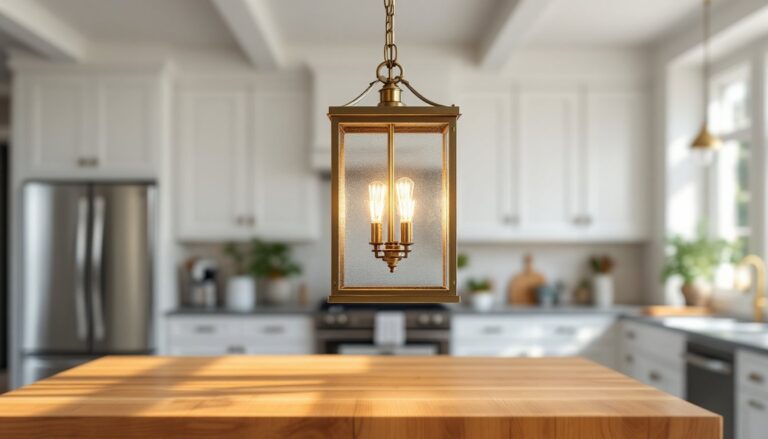
Don’t forget the island and sink. Pendant lights work well over islands, hang them 30-36 inches above the countertop to avoid head-bumping while maintaining good light coverage. Over the sink, a single pendant or a recessed can directly overhead handles the job. Pendants add style: recessed lights are purely functional. Choose based on your kitchen’s overall look and whether the sink area doubles as a design focal point.
Accent Lighting: Adding Style and Depth
Accent lighting is the optional-but-recommended layer that adds drama and visual interest. It highlights architectural features, creates depth, and makes your kitchen feel more custom. Common applications include lighting inside glass-front cabinets, toe-kick lighting under base cabinets, or uplighting on top of tall cabinets if there’s a gap to the ceiling.
LED strips are the go-to here as well, dimmable, low-profile, and available in a range of color temperatures. For in-cabinet lighting, use strips along the top or sides of the cabinet interior: avoid bottom-mounting or you’ll just light up your dishes’ undersides.
Toe-kick lighting isn’t just decorative, it provides subtle wayfinding at night without needing to flip on overhead lights. Install LED strips in the recessed toe-kick space at the base of your cabinets. Use a motion sensor or a separate switch so it doesn’t run all the time.
If you lean toward vintage or farmhouse aesthetics, consider accent fixtures that double as style statements. Vintage farmhouse lighting can add character above an island or in a breakfast nook, blending accent and task roles while reinforcing your design theme.
Choosing the Right Fixtures for Each Kitchen Zone
Not all fixtures are created equal, and matching the right type to each zone prevents buyer’s remorse and return trips to the home center.
Ceiling (Ambient): For general lighting, recessed cans offer flexibility and a modern look. Choose IC-rated (insulation contact) housings if you have insulation in the ceiling: non-IC if you don’t. Lighting systems that integrate with smart controls let you adjust brightness and scheduling without rewiring. Flush or semi-flush mounts work in kitchens with lower ceilings or where you want a more traditional look, just confirm the fixture is rated for damp or wet locations if it’s near a sink.
Island (Task + Accent): Pendants are the most popular choice. Hang two to three pendants for islands 6 feet or longer: a single large pendant works for smaller islands. Choose fixtures with downward-focused light (not just decorative bulbs visible from the side) to actually illuminate the work surface. If you go the recessed route instead, use adjustable trims so you can angle light where you need it. Design galleries like those on HGTV and Houzz show dozens of real-world pendant configurations to help narrow your style.
Under-Cabinet (Task): Go with hardwired linear LED bars if you’re doing a full remodel or if existing outlets are scarce. These offer the cleanest look and strongest output. Use plug-in LED strips for a quick retrofit, they’re less powerful but still effective and require no electrical permit. Battery-powered pucks are a last resort: they’re dim, need frequent battery swaps, and aren’t worth the hassle for primary task lighting.
Specialty Zones (Accent): For spot lighting inside glass cabinets or highlighting artwork, consider mini LED pucks or strip segments with separate switching. Keep these on a dimmer so you can dial them back when the kitchen isn’t in use, accent lights left at full brightness all evening create glare and visual fatigue.
Don’t mix fixture finishes randomly. Stick to one or two metal tones (e.g., brushed nickel and matte black) across all your light fixtures, cabinet hardware, and faucet to maintain visual coherence.
Color Temperature and Brightness: Getting the Balance Right
Color temperature is measured in Kelvin (K) and determines whether your light looks warm, neutral, or cool. For kitchens, the sweet spot is typically 2700K to 3000K (warm white) for ambient and accent layers, and 3500K to 4100K (neutral to cool white) for task lighting. Warmer light feels cozy and flattering: cooler light improves visibility and color accuracy when prepping food.
Don’t mix temperatures haphazardly. If your recessed cans are 3000K, your under-cabinet lights should be too, or at least within 500K. Mismatched color temps create a disjointed look and make finishes appear inconsistent.
Brightness (lumens) varies by layer. Ambient lighting needs 30-40 lumens per square foot, task areas need 50-75 lumens per square foot, and accent lighting is typically 10-20 lumens per square foot or whatever creates the desired effect. For task lighting specifically, err on the brighter side, you can always dim down, but you can’t add lumens after the fact.
Dimmer switches are non-negotiable for flexibility. Install dimmers on all three layers if possible, but at a minimum put them on ambient and island fixtures. Not all LEDs are dimmable, so check the bulb or fixture specs before buying. Incompatible combinations cause flickering, buzzing, or early burnout. Use an LED-compatible dimmer (often labeled “CL” or “LED”) rather than an old incandescent-style dimmer.
Finally, consider CRI (Color Rendering Index), a measure of how accurately a light source shows colors. Look for a CRI of 90 or higher for kitchen lighting, especially task zones. Lower CRI makes reds look muddy and whites look dingy, which is a problem when you’re checking if chicken is cooked or if that shirt is actually stained.
If you’re pursuing a more streamlined aesthetic, minimalist lighting design principles can guide you toward fixtures and layouts that maximize function without visual clutter. Just remember that “minimalist” doesn’t mean “dim”, clean design still requires adequate lumens and layered sources.
Pro tip: Buy one bulb or fixture first and test it in your space for a few days before committing to a full set. Light looks different on a showroom shelf than it does bouncing off your specific countertops and cabinet finishes. Most home centers accept returns on unopened boxes, so buy a few extra for spares and return what you don’t use.