



Table of Contents
ToggleMost living rooms suffer from a single overhead fixture doing all the heavy lifting, and it shows. Flat, uninviting light that washes out faces and leaves corners in shadow isn’t ambiance: it’s a missed opportunity. The best living room lighting doesn’t come from one expensive chandelier or a trendy floor lamp. It comes from layering three distinct types of light, ambient, task, and accent, so the space works for movie nights, book clubs, and everything in between. This guide walks through each layer, the fixtures that deliver them, and the dimming and bulb choices that tie it all together.
Key Takeaways
- Best living room lighting combines three distinct layers—ambient, task, and accent—rather than relying on a single overhead fixture.
- Ambient lighting requires approximately 1.5 to 2 watts per square foot of incandescent equivalent (or 0.25 to 0.35 watts LED) for safe, comfortable navigation.
- Task lighting, such as floor lamps and desk lights with 90+ CRI, should be paired with dimmed ambient light at 30–50% to reduce eye strain and contrast fatigue.
- Accent lighting adds visual depth and personality by highlighting artwork, architectural features, or textured elements using picture lights, wall sconces, or recessed adjustable trims.
- Choose warm-white bulbs between 2700K and 3000K for living rooms to flatter skin tones, and install dimmers or smart controls to adjust intensity independently for different activities like reading, movie nights, or entertaining.
- Avoid mixing color temperatures in the same room, and prioritize LED bulbs with CRI 90 or higher to accurately reveal colors and prevent flat, washed-out spaces.
Why Layered Lighting Transforms Your Living Room
Single-source lighting creates a one-note room. A ceiling fixture alone casts harsh shadows and offers no flexibility for different activities. Layered lighting solves this by stacking three types: ambient (general illumination), task (focused light for specific activities), and accent (decorative or architectural emphasis).
This approach mirrors how natural light shifts throughout the day. Morning sunlight floods the room: evening light is softer and directional. Layering artificial sources replicates that variety, letting homeowners dial up brightness for cleaning or dim down for conversation.
From a practical standpoint, layered lighting also reduces eye strain. Task lights prevent squinting over a laptop or book, while ambient sources fill in the gaps without glare. Accent lights add depth, making the room feel larger and more intentional.
Most living rooms benefit from at least one fixture in each category. Larger or open-concept spaces may need multiples, two table lamps flanking a sofa, a pair of recessed cans highlighting artwork, or a combination of pendant and LED panel lights for even ceiling coverage. The key is balance: no single layer should dominate, and each should be controllable independently.
Ambient Lighting: Creating Your Living Room’s Foundation
Ambient lighting is the base layer, the general illumination that lets you navigate the room safely and comfortably. It typically comes from overhead sources: ceiling fixtures, recessed cans, or track lighting.
Ceiling-mounted fixtures are the workhorse. A flush-mount or semi-flush fixture works in rooms with 8-foot ceilings: anything taller can accommodate a chandelier or pendant. For even coverage, aim for 1.5 to 2 watts per square foot of incandescent equivalent (or 0.25 to 0.35 watts per square foot for LED). A 200-square-foot living room needs roughly 300–400 watts of incandescent equivalent, or 50–70 watts of LED.
Recessed lighting offers flexibility. Standard 4-inch or 6-inch cans with baffle or reflector trims spread light broadly. Space them 4 to 6 feet apart in a grid pattern, keeping the first row about 3 feet from the wall to avoid harsh shadows. Use IC-rated housings if installing near insulation in the ceiling.
Track lighting works well in rooms where you want to adjust beam direction over time. It’s especially useful in open-concept layouts where the “living room” bleeds into dining or kitchen zones. Just ensure the track system is rated for the total wattage of all attached heads.
Don’t overlook natural light. Windows and skylights reduce daytime reliance on artificial sources, but they’re not controllable after dark. Ambient fixtures fill that gap, and dimmers let you match their output to the time of day.
Task Lighting: Functional Fixtures for Reading and Activities
Task lighting targets specific activities: reading, crafting, working on a laptop, or any close-up work that demands focused brightness. Without it, ambient light alone forces you to squint or reposition furniture.
Floor lamps are the most common task solution. Look for adjustable-arm or gooseneck models that let you direct light exactly where it’s needed. A three-way bulb (50/100/150W incandescent equivalent, or 7/14/21W LED) offers flexibility without replacing the fixture. Position the lamp so the bulb sits at shoulder height when seated, too high and it glares, too low and it casts shadows on your work.
Table lamps flanking a sofa or armchair serve double duty: task light for reading and decorative accent when dimmed. Choose opaque or semi-opaque shades to minimize glare: translucent shades diffuse light but can be too bright for TV viewing. Swing-arm wall sconces are another option if floor space is tight, just make sure they’re wired during construction or remodeling, as retrofitting drywall is messy.
For home offices or hobby corners within the living room, consider a desk lamp with a color-rendering index (CRI) of 90 or higher. High-CRI bulbs reveal true colors, critical for tasks like sewing, painting, or reviewing printed materials. A clamp-on lamp works if you’re short on desk space.
Task lighting should never be the sole source in a room. It creates harsh contrast that fatigues eyes over time. Pair it with ambient lighting set to 30–50% output, so the background isn’t pitch black.
Accent Lighting: Adding Drama and Visual Interest
Accent lighting is where personality lives. It highlights architectural features, artwork, plants, or textured walls, anything worth drawing the eye toward. Done well, it adds depth and makes a room feel curated.
Picture lights mount above or below framed art. LED strips or battery-powered puck lights work for renters or anyone avoiding electrical work. For hardwired installations, aim the beam at a 30-degree angle to minimize glare on glass. A common rule: the fixture should be one-third to one-half the width of the artwork.
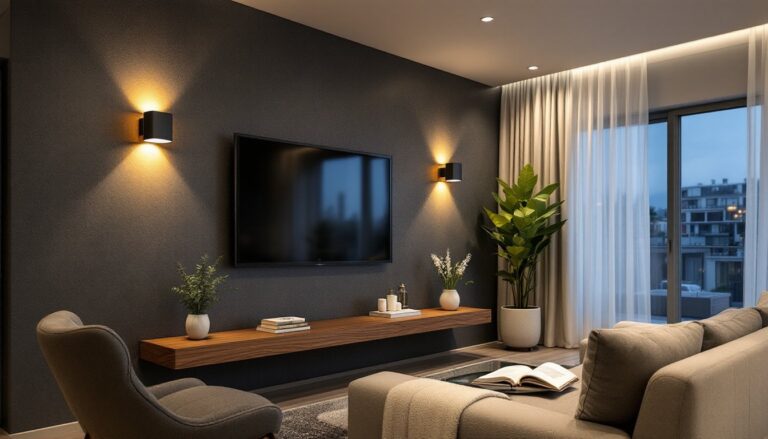
Wall sconces provide both up-light and down-light, depending on the design. Up-lighting washes the ceiling and makes low ceilings feel taller: down-lighting creates pools of illumination on walls or floors. Install sconces 60 to 66 inches above the floor for general accent use, or higher if they’re flanking a fireplace or tall bookshelf.
Recessed adjustable trims (also called “eyeball” or “gimbal” trims) let you spotlight specific objects from the ceiling. They’re ideal for highlighting a gallery wall, a sculptural chair, or built-in shelving. Use narrow beam angles (15–25 degrees) for dramatic effect, or wider beams (40–60 degrees) for softer emphasis.
LED strip lighting hidden behind crown molding, under floating shelves, or inside glass-front cabinets creates indirect glow. Choose high-density strips (300+ LEDs per 16-foot reel) for smooth, consistent light without visible dots. Designers often incorporate spot lighting to draw attention to standout decor pieces without overwhelming the room.
Accent fixtures should be two to three times brighter than ambient light to create noticeable contrast, but not so bright they become the dominant source. Dimmers are essential here.
Choosing the Right Bulbs and Color Temperature
Bulbs matter as much as fixtures. The wrong color temperature or CRI turns a well-designed lighting plan into a sterile showroom or a dingy basement.
Color temperature is measured in Kelvins (K). For living rooms, stick to the 2700K to 3000K range (warm white). This mimics incandescent bulbs and flatters skin tones. Anything above 3500K skews blue and feels clinical, fine for garages, not for spaces where people gather. If you want flexibility, tunable white bulbs shift from 2200K (candlelight) to 5000K (daylight) via an app or remote.
CRI (Color Rendering Index) rates how accurately a bulb reveals colors, on a scale of 0–100. Incandescent bulbs score 100: most LEDs range from 80 to 95. Aim for CRI 90+ in living rooms, especially if you display art, textiles, or plants. Lower-CRI bulbs wash out reds and greens, making spaces feel flat.
Lumens measure brightness. A standard 60W incandescent produces about 800 lumens: a 100W bulb hits 1600. LED equivalents use far less energy: an 800-lumen LED draws 8–10 watts. For ambient fixtures, calculate total lumens needed (1.5–2W per square foot, converted to lumens), then divide by the number of bulbs. Task lights should deliver 300–500 lumens at the work surface: accent lights vary by application.
Bulb shape and base affect beam spread. A19 bulbs are omnidirectional: BR30/BR40 (flood) and PAR30/PAR38 (spot) bulbs have built-in reflectors for directional light, ideal for recessed cans. Make sure the base (E26 medium screw, GU10 twist-lock, etc.) matches your fixture.
Many designers integrate minimalist lighting design principles, choosing bulbs and fixtures that provide function without visual clutter. Avoid mixing color temperatures in the same room, consistency is key.
Smart Controls and Dimming Solutions
Dimmers and smart controls are the difference between a functional lighting plan and a truly flexible one. They let you adjust intensity and color without swapping bulbs or fixtures.
Dimmer switches work with dimmable LED, incandescent, and halogen bulbs. Not all LEDs dim smoothly, check the packaging for “dimmable” labeling and pair with an LED-rated dimmer to avoid flickering or buzzing. Lutron and Leviton make reliable residential dimmers: expect to spend $15–$50 per switch depending on features. Install them on ambient and accent circuits: task lights are often used at full brightness and don’t need dimming.
Smart bulbs (Philips Hue, LIFX, Wyze) offer app control, scheduling, and color-changing. They’re easiest for renters or anyone avoiding electrical work, just screw in the bulb and connect to Wi-Fi. Downside: they’re expensive ($10–$60 per bulb) and require the switch to stay in the “on” position, which confuses guests.
Smart switches (Lutron Caséta, TP-Link Kasa) replace existing switches and control any bulb, dimmable or not. They integrate with Alexa, Google Home, and Apple HomeKit for voice control and automation. Installation is straightforward if you’re comfortable with basic wiring (turn off the breaker first). Some models require a neutral wire: older homes may lack one, necessitating a different switch type or an adapter.
Wireless remotes and motion sensors add convenience without a full smart-home setup. Battery-powered remotes stick to walls or sit on tables: sensors automatically turn on lights when someone enters and off after a set period. Ideal for entryways that flow into living rooms.
For open-concept spaces, consider scene control: pre-programmed settings that adjust multiple fixtures at once. “Movie mode” might dim ambient lights to 20%, turn off task lamps, and leave one accent sconce at 50%. “Cleaning mode” cranks everything to 100%. Many lighting systems now support these presets out of the box.
Conclusion
Layered lighting isn’t about buying the most fixtures, it’s about choosing the right ones and controlling them independently. Start with a solid ambient foundation, add task lights where you actually sit and work, then use accent fixtures to highlight what makes the room yours. Pair it all with dimmable, warm-white LEDs and a control system that fits your habits, whether that’s a basic dimmer or a full smart setup. The result is a living room that adapts to how you live, not the other way around.