

Table of Contents
ToggleOutdoor lighting does more than help you find your keys at night. It extends usable living space, highlights architectural features, improves safety, and deters break-ins. But walk into any home center and you’ll face a wall of fixtures, each claiming to be perfect for your needs. The truth is, different areas of your property require different lighting approaches. A motion-activated floodlight makes sense for a driveway but would annoy dinner guests on a patio. This guide breaks down the major categories of outdoor lighting, explains what each type does best, and helps homeowners choose fixtures that actually match how they use their outdoor spaces.
Key Takeaways
- Different areas of your outdoor space require different types of outdoor lighting—path lights for wayfinding, accent lights for ambiance, and floodlights for security—each with specific placement and brightness needs.
- Low-voltage LED path and landscape lighting systems are safer to install, energy-efficient, and cause less light pollution than halogen alternatives, using 75% less energy while lasting 25,000+ hours.
- Motion-sensor security floodlights should be mounted 8-10 feet high with adjustable sensitivity and timer settings, positioned to overlap coverage zones and eliminate dark corners that pose liability risks.
- Wall-mounted sconces for entryways should be positioned 66-72 inches high and provide 800-1,200 lumens, with wet-rated fixtures required in exposed locations and damp-rated fixtures acceptable only under covered areas.
- Deck and patio lighting combines task lighting (recessed dots, post caps, and grill lights) with ambient options (string lights, under-rail strips) to create a flexible outdoor room for cooking, dining, and relaxation.
- Test outdoor lighting placement after dark and adjust before permanent installation to ensure fixtures feel natural and actually match how you use your outdoor spaces, rather than appearing staged or overdone.
Path and Walkway Lighting
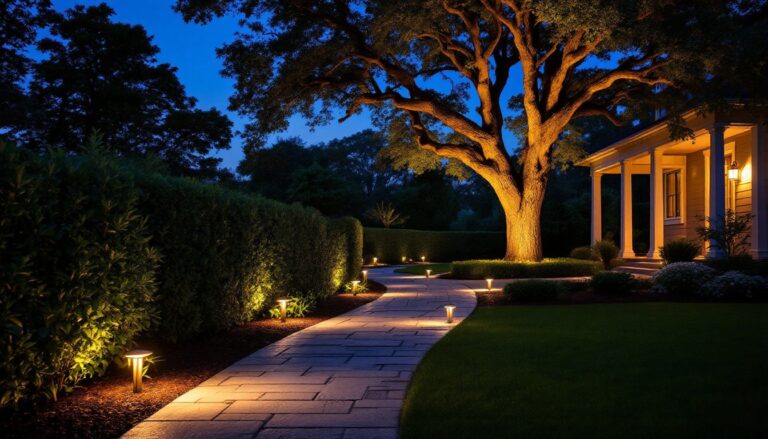
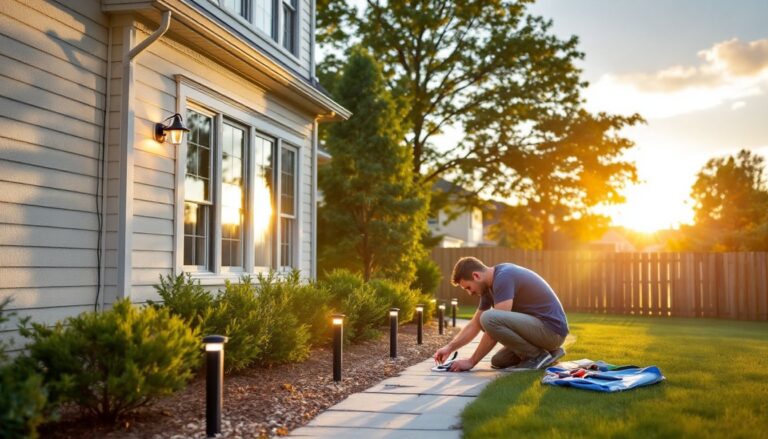
Path lights do one job well: they mark routes from the driveway to the front door, around garden beds, or along stepping stones without blinding anyone. Most stand 18 to 24 inches tall and space 8 to 10 feet apart for even coverage.
Low-voltage LED systems dominate this category. They run on a transformer that steps household 120V current down to 12V, which is safer to install (no electrical permit required in most jurisdictions) and less likely to cause shocks if a line gets nicked during lawn care. A 150-watt transformer typically powers 10 to 15 fixtures depending on bulb wattage.
Look for fixtures with downward-facing or shielded lenses. Exposed bulbs create glare and light pollution: good path lights cast a pool of light on the ground, not into your eyes. Metal housings (aluminum, brass, copper) outlast plastic in UV exposure and lawn-mower impacts.
Bollard lights, short, post-style fixtures, offer a modern alternative to traditional mushroom-cap path lights. They work well along driveways or contemporary landscapes. Choose 3000K to 4000K color temperature for a neutral white that doesn’t skew too yellow or blue. Warmer temps (2700K) suit traditional homes: cooler temps suit modern designs.
Solar path lights have improved, but they still underperform in shaded yards or during winter months when daylight is short. If you go solar, buy from companies that allow battery replacement, cheap units with sealed batteries become landfill waste in two years.
Landscape and Garden Lighting
This is where outdoor lighting gets creative. Landscape lighting uses small, directional fixtures to highlight trees, shrubs, architectural details, or water features. The goal is drama and depth, not widespread illumination.
Spotlights and uplights sit at ground level or on stakes, aiming beams upward into tree canopies or against stone walls. Use narrow beam angles (10–25 degrees) to spotlight a single trunk or focal point: wider floods (60 degrees or more) wash entire plantings or fence sections. A basic spot lighting setup for a mature oak might use a 10-watt LED uplight placed 3 to 4 feet from the trunk.
Well lights recess into the ground, sitting flush with soil or mulch. They’re ideal under eaves or near hardscaping where a stake would be visible. Make sure the housing is IP67-rated (dust-tight and waterproof to 1 meter) to survive sprinkler cycles and standing water.
Path vs. accent: Path lights provide wayfinding: accent lights create ambiance. Don’t confuse the two. Accent fixtures should be subtle, 3 to 5 watts per fixture, and placed so the fixture itself disappears into landscaping. If you see the bulb, the effect is ruined.
Pro tip: Use a mix of techniques. Uplight a tree, downlight from a pergola beam, and cross-light a garden statue from two angles. Layering creates dimension. And always install landscape lighting on a separate zone or dimmer, you don’t want path lights on the same switch as decorative accents.
Consider systems with energy-efficient lighting options, especially if you plan to leave fixtures on for extended hours. LED systems use 75% less energy than halogen equivalents and last 25,000 hours or more.
Security and Floodlights
Security lights aren’t subtle. They’re meant to flood large areas, driveways, backyards, side yards, with bright, even light when triggered by motion or a timer. Most use LED bulbs ranging from 20 to 50 watts, producing 2,000 to 5,000 lumens.
Motion-sensor floodlights are the workhorse of home security. Look for models with adjustable sensitivity, timer length (1 to 10 minutes), and range settings (20 to 70 feet). Cheap sensors trigger on every stray cat: quality units let you fine-tune detection zones. Install sensors 8 to 10 feet high for best coverage and aim them slightly downward to avoid false triggers from passing cars or tree branches.
Many newer fixtures include dual-brightness modes: a low-level “dusk-to-dawn” setting (10% brightness) that switches to full power when motion is detected. This balances security with energy use and reduces light pollution.
Floodlight placement matters. Mount them under eaves or soffits to protect the fixture and prevent direct rain exposure, even on weatherproof models. Aim to overlap coverage zones, if one light covers the driveway, position a second to catch the walkway and side gate. Dark corners are liability risks.
Wiring vs. battery: Hardwired fixtures require a junction box and 120V circuit, which means either tapping an existing exterior outlet or running new wire from a breaker panel. This typically requires a permit and may call for a licensed electrician, depending on local codes. Battery-powered options exist, but expect to swap batteries every 6 to 12 months with frequent use.
Smart floodlights integrate with home automation systems, allowing remote control, scheduling, and integration with cameras. They cost more upfront but eliminate the need for separate timers or photocells.
Deck and Patio Lighting
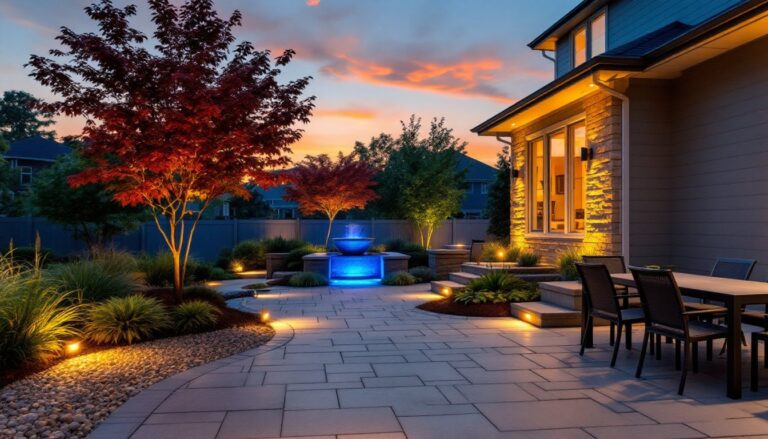
Decks and patios need task lighting for cooking and dining plus ambient lighting for atmosphere. Mixing the two creates a flexible outdoor room.
Recessed deck lights (also called deck dots) mount flush into deck boards, stair risers, or post caps. Most are low-voltage (12V) and require holes drilled into joists or rim boards during construction or retrofit. Space them 6 to 8 feet apart along railings or one per step on stairs for code compliance in many areas. Warm white LEDs (2700K–3000K) soften the space: cool whites feel clinical.
Post-cap lights sit atop railing posts, casting light downward and outward. They add a finished look and provide perimeter lighting without taking up deck real estate. Choose caps sized to your post dimensions, standard sizes fit 4×4 or 6×6 nominal posts (actual dimensions 3.5 x 3.5 or 5.5 x 5.5 inches).
String lights and bistro lighting have become standard on patios. Edison-style bulbs suspended on 18- to 24-inch spacing create a casual, restaurant vibe. Run cable between posts, pergola beams, or exterior walls: use screw-in hooks or cable guides rated for outdoor use. Most string sets are 120V plug-in, but low-voltage and solar options exist.
For a more polished look, install under-rail lighting, linear LED strips that mount beneath the top railing cap and wash the deck surface. These work especially well on composite or PVC railings where you can conceal wiring inside hollow channels.
Don’t forget the grill area. A dedicated task light, either a clamp-on LED or a wall-mounted fixture, prevents undercooked chicken and burned fingers. Look for fixtures rated for heat exposure if mounting near a grill hood.
Wall-Mounted and Sconce Lighting
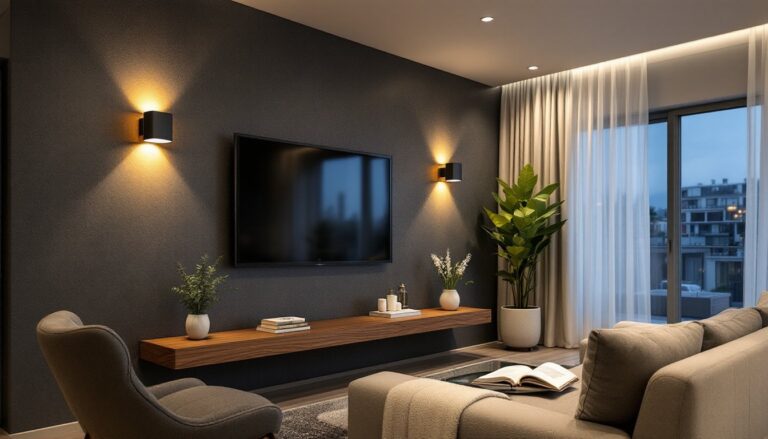
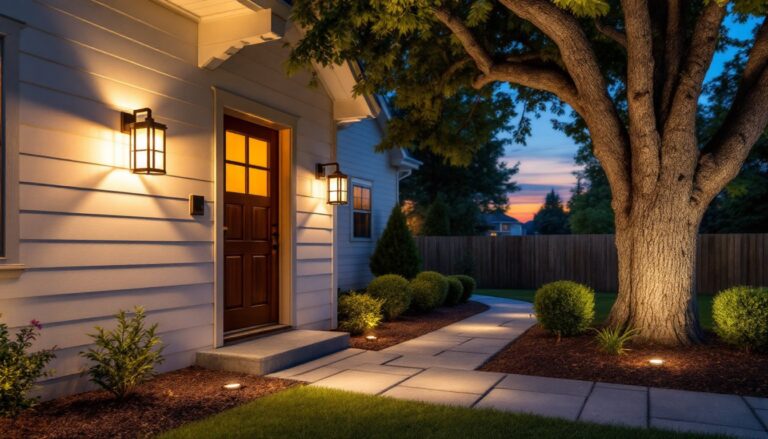
Wall sconces frame entryways, garages, and patio doors. They’re the most visible fixtures on most homes, so style matters as much as function. But they also need to provide enough light for safe entry and exit.
Mounting height for entryway sconces is typically 66 to 72 inches from the ground (center of fixture), or about one-third the height of the door. For an 8-foot door, mount fixtures around 64 inches high. Flanking a door with matching sconces creates symmetry: a single fixture works if the door is off-center or if you’re adding a house number plaque.
Bulb type and brightness: Most sconces use A19 or A21 Edison-base bulbs or built-in LEDs. For a standard front door, aim for 800 to 1,200 lumens per fixture (equivalent to a 60–75W incandescent). If the fixture has a frosted or seeded glass shade, you can use a brighter bulb without glare: clear glass requires a lower-wattage bulb or a dimmer.
Wet vs. damp ratings: This is non-negotiable. Damp-rated fixtures are fine under a covered porch where they won’t get direct rain. Wet-rated fixtures are required on open walls, pergolas, or anywhere exposed to weather. Check the label or product specs, installing a damp-rated fixture in a wet location voids the warranty and creates a shock hazard.
Photocell and timer options: Many wall fixtures now include built-in dusk-to-dawn photocells or can be wired to a timer or smart switch. This prevents the “lights on all day” problem when someone forgets to turn them off. A lighting system that integrates timers and sensors can simplify control across multiple fixtures.
Specialty Outdoor Lighting Options
Beyond the standard categories, a few specialty fixtures solve specific problems or add unique effects.
Underwater and pond lights require IP68 ratings and low-voltage wiring. They highlight waterfalls, fountain sprays, or koi ponds. Use colored LEDs sparingly, one blue accent is dramatic: five looks like a miniature golf course. Submersible fixtures need annual maintenance to clear algae and debris from lenses.
Step and riser lights mount horizontally into stair risers or vertically into stair treads, meeting code requirements for illuminated stairs in many jurisdictions. The International Residential Code (IRC) requires artificial light at the top and bottom of stairs: integrated step lights satisfy this and add safety.
Grazing lights are narrow-beam fixtures installed very close to a textured wall (stone, brick, stucco) to emphasize surface relief. Place them 6 to 12 inches from the wall and aim them up or down. Grazing exaggerates texture: washing (from farther away) softens it.
In-ground linear lights fit into concrete or paver joints, creating seamless lines of light along walkways or pool edges. They require precise installation during hardscape construction, not a retrofit project.
Portable lighting like rechargeable LED lanterns or tabletop fixtures adds flexibility for seasonal use or outdoor dining. These don’t require wiring and can move with furniture layouts.
Conclusion
Good outdoor lighting isn’t about more fixtures, it’s about the right fixtures in the right places. Start with safety and function (paths, entries, stairs), then layer in accent and ambient lighting where it enhances how you actually use the space. Choose fixtures rated for the exposure they’ll face, and don’t cheap out on transformers or wire gauge for low-voltage runs. Most importantly, test before you trench or mount permanently. Set fixtures on the ground after dark, walk the space, and adjust until the lighting feels natural rather than staged.