



Table of Contents
ToggleLighting a kitchen right means balancing function with ambiance, and most homeowners get it backward. They pick a single overhead fixture, wonder why chopping vegetables feels like surgery in a cave, then add a lamp on the counter. Sound familiar? The good news: fixing kitchen lighting doesn’t require an electrician for every step, and the right fixtures make prep work safer, cooking more enjoyable, and the whole space more inviting. This guide walks through fixture types, layering strategies, and style choices that’ll turn a dim kitchen into a well-lit workspace without the guesswork.
Key Takeaways
- Proper kitchen lighting fixtures require balancing three layers—ambient, task, and accent lighting—to improve both safety and ambiance without guesswork.
- Under-cabinet and pendant lighting eliminate shadows during food prep work, reducing knife accidents and improving precision for tasks like measuring and checking doneness.
- Recessed lighting and pendant fixtures should maintain consistent color temperature between 3000K and 3500K across all fixtures to avoid a disjointed appearance.
- For kitchen islands, hang two to three pendants 30 to 36 inches above the countertop, sizing them one-quarter to one-third the island’s width for proper proportion.
- LED retrofit kits and under-cabinet LED strips offer DIY-friendly upgrades that require minimal wiring, making kitchen lighting improvements accessible without professional installation.
- Match lighting fixture finishes to cabinet hardware to create visual flow, and prioritize task lighting functionality before investing in decorative statement pieces.
Why Choosing the Right Kitchen Lighting Fixtures Matters
Kitchens demand more from lighting than any other room. It’s where precision tasks, dicing onions, reading recipes, spotting whether that chicken’s cooked through, happen alongside social gatherings and late-night snack runs. Poor lighting creates shadows on countertops, makes color judgment nearly impossible (hello, over-salted soup because you couldn’t see the measuring spoon), and turns a kitchen into a place people avoid after dark.
From a safety standpoint, inadequate lighting increases knife accidents and burns. The National Kitchen and Bath Association (NKBA) recommends a minimum of 50 lumens per square foot for general kitchen lighting, with task areas needing significantly more. But lumens alone don’t tell the whole story, fixture placement, color temperature (measured in Kelvins), and beam spread all affect how usable the light actually is.
Beyond function, lighting sets the mood. A well-lit kitchen with dimmer controls transitions from bright task mode during meal prep to softer ambient lighting for dinner guests. Layering different fixture types, ambient, task, and accent, gives control over both practicality and atmosphere. Skimp on planning, and you’ll either live with the problem or face a retrofit that involves patching drywall and running new electrical boxes.
Types of Kitchen Lighting Fixtures and Their Best Uses
Pendant Lights: Stylish Task Lighting for Islands and Counters
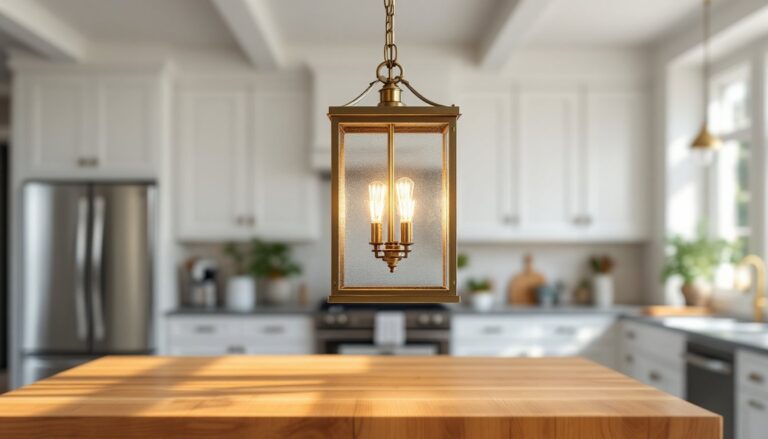
Pendant fixtures hang from the ceiling on a cord, chain, or rod, directing light downward. They’re the go-to choice for kitchen islands and peninsulas because they provide focused task lighting exactly where you prep, eat, or gather. Mounting height matters: hang pendants 30 to 36 inches above the countertop for islands, slightly higher if the fixture has a wide shade that could block sightlines.
Most kitchens benefit from two or three pendants spaced evenly over an island, rather than one large fixture. For an island that’s 6 feet long, two pendants work: 8 feet or longer, go with three. Wiring multiple pendants to a single junction box is straightforward if you’re comfortable with basic electrical work, but always turn off the breaker and use a voltage tester before touching any wires. If you’re replacing an existing fixture, the electrical box is already there, just confirm it’s rated for the new fixture’s weight.
Pendants come in countless styles, from industrial metal shades to blown glass globes. For task-focused areas, choose fixtures with opaque or semi-opaque shades that direct light downward without glare. Glass or open-frame pendants provide ambient light but won’t illuminate a cutting board as effectively. Many minimalist pendant designs pair well with modern kitchens while delivering strong task lighting.
Recessed Lighting: Clean, Modern Ambient Illumination
Recessed lights (often called can lights or downlights) sit flush with the ceiling, making them ideal for kitchens with low ceilings or a modern aesthetic. They provide ambient lighting, general, even illumination that fills the room, and can also serve as task lighting when positioned over work areas.
Installing recessed lighting in an existing ceiling is more involved than swapping a pendant. You’ll need to cut holes, run cable between joists, and install IC-rated (insulation contact) or non-IC housings depending on what’s above the ceiling. Spacing matters: a common rule is to divide ceiling height by two to get spacing in feet. For an 8-foot ceiling, space fixtures roughly 4 feet apart. Closer spacing over countertops gives better task lighting: wider spacing works for general ambient coverage.
LED retrofit kits make upgrading old incandescent recessed cans easy, most install in under five minutes per fixture without touching the wiring. Look for kits with a color temperature between 3000K and 4000K for kitchens: 3000K leans warm (cozy, less clinical), while 4000K is bright white (better color rendering for cooking). Many newer designs from major kitchen design sources feature adjustable trim that angles light toward work surfaces instead of just straight down.
Under-Cabinet Lighting: Essential Task Lighting for Prep Areas
Under-cabinet lights mount to the underside of wall cabinets, casting light directly onto countertops. This eliminates the shadows your body creates when working under overhead lighting, critical for tasks like knife work or reading measuring cups. Without it, you’re essentially working in your own shadow.
Three main types dominate: puck lights (small, round fixtures that create pools of light), LED strip lights (continuous ribbons that provide even coverage), and linear bar lights (rigid bars that split the difference). LED strips offer the most uniform illumination and are the easiest to install, most plug into an outlet and stick to the cabinet with adhesive backing. Hardwired versions require running cable through the cabinet interior and connecting to a switch, which is cleaner but more involved.
Most under-cabinet LED strips draw so little power (around 4 to 6 watts per foot) that you can run several on a single 15-amp circuit. If you’re starting from scratch, consider installing a switch near the main light switch or adding them to a smart home system for control via app or voice. Some DIYers install under-cabinet lighting themselves in an afternoon: the key is measuring carefully, cutting strips at designated points only, and using proper wire connectors if linking multiple strips.
How to Layer Your Kitchen Lighting for Maximum Function and Style
Effective lighting systems rely on three layers: ambient, task, and accent. Ambient lighting provides overall illumination, typically from recessed lights, flush-mount ceiling fixtures, or a central pendant. Task lighting focuses on work areas, under-cabinet lights, pendants over islands, or track lighting aimed at the stove and sink. Accent lighting highlights architectural features, open shelving, or decorative elements, think small spotlights inside glass-front cabinets or toe-kick LEDs.
Start with ambient. Calculate total lumens needed by multiplying your kitchen’s square footage by 50 lumens (e.g., a 150-square-foot kitchen needs roughly 7,500 lumens total). Divide that among your ambient fixtures. Four recessed lights at 1,200 lumens each plus a central pendant at 2,400 lumens gets you close.
Next, add task lighting where you actually work: countertops, the sink, the range, and the island. This is where under-cabinet strips and focused pendants shine. Many jurisdictions don’t require permits for low-voltage LED installations, but hardwired fixtures (anything connected directly to household circuits) often do. Check local codes before cutting into walls.
Finally, layer in accent lighting. It’s optional but makes a big difference in perceived quality. Small puck lights or spot lighting can highlight backsplashes, artwork, or open shelving. Installing dimmers on all three layers gives flexibility, bright for cooking, dim for ambiance.
Color temperature consistency matters. Mixing 2700K (warm yellow) pendants with 5000K (blue-white) recessed lights looks disjointed. Stick within a 500K range across all fixtures, ideally 3000K to 3500K for a balanced, natural feel.
Choosing the Right Fixture Styles for Your Kitchen Design
Fixture style should complement the kitchen’s overall design without overwhelming it. In a modern kitchen with flat-panel cabinets and stainless appliances, sleek pendants with geometric shapes or brushed nickel recessed trims keep the look cohesive. Traditional kitchens with raised-panel cabinets and crown molding pair well with vintage farmhouse lighting, think seeded glass shades, oil-rubbed bronze finishes, or industrial cage pendants.
Scale and proportion matter more than most DIYers realize. A pendant that’s too small over a large island looks lost: one that’s too big dominates the space and blocks sightlines. A general guideline: pendant diameter in inches should be roughly one-quarter to one-third the width of the island in feet. For a 4-foot-wide island, pendants around 12 to 16 inches in diameter work well.
Finish consistency ties the room together. If cabinet hardware is brushed nickel, matching pendant and recessed trim finishes to that creates visual flow. Mixing metals (like matte black pendants with brass cabinet pulls) can work but requires a confident design eye, safer to pick one primary finish and stick with it.
Current kitchen lighting trends lean toward statement pendants, especially oversized or clustered designs, but trends shift. Classic fixtures, simple drum shades, schoolhouse globes, clear glass pendants, age better than overly trendy designs. If budget’s tight, invest in quality task lighting first, then upgrade decorative pendants later.
For lower ceilings (under 8 feet), avoid long-hanging pendants: instead, use flush-mount fixtures or short-drop pendants. Anything hanging more than 12 inches risks head bumps. In kitchens with high ceilings (9 feet or taller), longer drops and larger fixtures feel more proportional and prevent the ceiling from appearing cavernous.
Safety note: Always wear safety glasses when installing overhead fixtures, especially recessed lights that require cutting into drywall. Turn off power at the breaker, not just the switch, and confirm it’s off with a voltage tester. If your home was built before 1985 and has original fixtures, consider having an electrician inspect the wiring, older cloth-insulated wiring degrades and can pose fire risks when overloaded with new LED retrofits that allow higher wattages.