

Table of Contents
ToggleOutdoor wall sconces do more than brighten a porch, they’re the difference between a forgettable facade and one that draws the eye from the curb. A well-placed sconce improves visibility around entries, deters would-be intruders, and adds architectural depth after dark. With advances in LED efficiency, photocell controls, and weatherproof construction, today’s fixtures handle everything from coastal salt spray to freeze-thaw cycles without constant re-lamping. Whether you’re updating a mid-century ranch or a new-build farmhouse, the right sconce ties together style, safety, and energy savings in a single junction box.
Key Takeaways
- Outdoor wall sconce lighting enhances security, curb appeal, and safety by eliminating dark entry points and improving visibility for emergency responders and residents after dark.
- Choose between traditional lantern-style, modern geometric, and contemporary up/down sconces based on your home’s architecture, ensuring fixtures are properly rated for wet or damp locations.
- Outdoor wall sconce fixtures should be scaled to your door height (divide door inches by 12 to get fixture height in feet) and mounted 65–70 inches to center for optimal balance and visibility.
- LED retrofits and integrated-LED sconces offer 15,000–50,000 hours of life while reducing energy consumption to 9–15 watts per fixture, making them ideal for long-term cost savings.
- Photocell and motion-sensor controls automate outdoor wall sconce lighting to save energy while providing convenience, with smart bulbs and switches enabling remote scheduling through mobile apps.
- Proper installation requires weatherproof electrical boxes, waterproof wire connectors, masonry anchors for durable surfaces, and caulking around the backplate to prevent water infiltration and thermal damage.
Why Outdoor Wall Sconces Are Essential for Modern Homes
Security tops the list. Motion-activated or dusk-to-dawn sconces eliminate dark corners near doors, garages, and side gates where intruders prefer to work. A 2024 Department of Justice study found that homes with visible perimeter lighting see a measurable drop in break-in attempts compared to unlit properties.
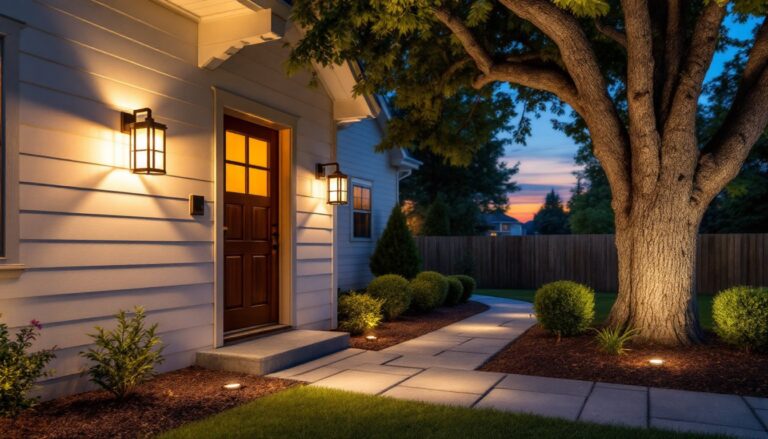
Curb appeal comes next. Real-estate agents know that exterior lighting photographed at twilight adds perceived value. A pair of sconces flanking a front door creates symmetry, while a single statement fixture beside a garage entry adds visual interest without clutter.
Wayfinding and safety matter after dark. Steps, threshold changes, and uneven pavers become trip hazards without adequate light. The International Residential Code (IRC) doesn’t mandate exterior entry lighting in most zones, but insurance carriers increasingly ask about it during home inspections. Task lighting near house numbers also helps emergency responders locate addresses faster.
Finally, sconces extend usable outdoor hours. A well-lit patio or deck becomes a functional space for evening meals, package drop-offs, or late-night dog walks. Solar gain and heat-island effects make outdoor rooms popular in warmer climates, and western living outdoor entertaining ideas often emphasize layered lighting for comfort and ambiance.
Types of Outdoor Wall Sconce Lighting for Every Style
Traditional and Lantern-Style Sconces
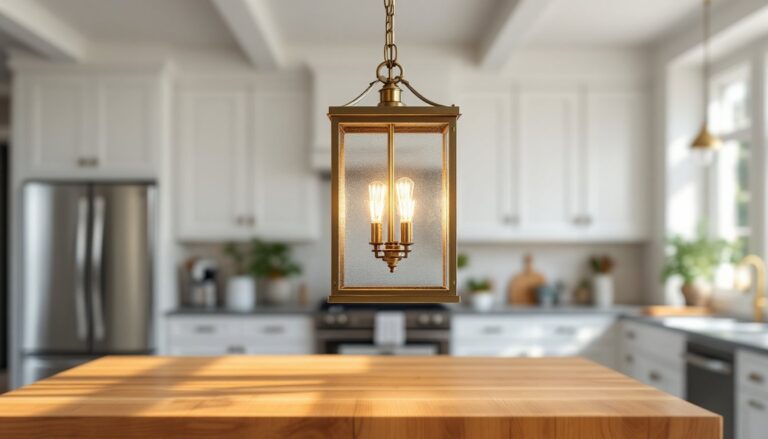
Lantern sconces remain the default for Colonial, Craftsman, and Cape Cod exteriors. Look for powder-coated aluminum or brass housings with clear or seeded glass panels. Authentic reproductions use E26 medium-base sockets, so you can retrofit LED filament bulbs that mimic incandescent glow without the 60-watt heat load.
Mounting height for flanking fixtures typically runs 66 to 72 inches from the finished floor to the center of the backplate, depending on door height. Oversized lanterns, 18 inches or taller, suit double doors or two-story entries: smaller 12-inch models work for side doors and garages.
Many traditional designs now ship with integrated photocell sockets that thread into the E26 base, letting you add automatic dusk-to-dawn operation without rewiring. This is a clean retrofit on older homes where running low-voltage control wire would mean opening walls.
Modern and Contemporary Wall Sconces
Contemporary sconces favor geometric forms: cylinders, rectangles, and asymmetric shields in matte black, graphite, or brushed nickel finishes. Materials include powder-coated steel, marine-grade stainless (304 or 316 for coastal zones), and cast aluminum.
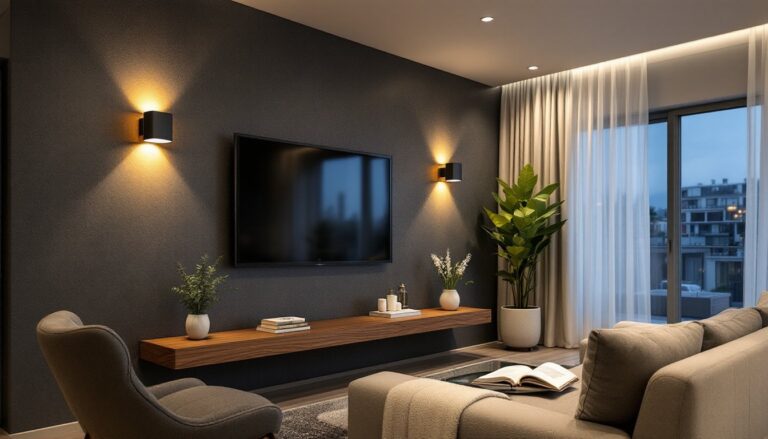
Up/down lighting is a hallmark of modern design. Fixtures with top and bottom apertures wash the wall with overlapping cones, highlighting siding texture or stone veneer. Single-direction sconces work well under eaves where uplight would spill into soffits.
Integrated-LED models dominate this category. The LED array mounts directly to a heat sink, eliminating the bulb socket entirely. Lumen output ranges from 400 lm (ambient) to 1,200 lm (task). Color temperature matters: 2700 K warm white suits residential settings, while 3000 K neutral white works for garages and workshops. Most integrated fixtures are not field-serviceable, when the LED dies (typically 25,000 to 50,000 hours), you replace the entire module or fixture.
For DIY home projects and design inspiration, mixing sconce styles within zones can work if finishes stay consistent. A modern cylinder beside the front door and a linear wall light over the garage keeps the palette unified even when forms differ.
How to Choose the Right Outdoor Wall Sconce for Your Home
Start with wet-location or damp-location ratings. The Underwriters Laboratories (UL) wet label means the fixture can handle direct rain, spray, and snow. Damp-rated sconces belong under covered porches or soffits where moisture is present but not direct. Check the label on the junction box or in the fixture spec sheet, this isn’t optional.
Scale the fixture to the wall and door. A good rule: measure door height in inches, divide by twelve, and use that number in feet as a guideline for fixture height. A 96-inch door (8 feet) suggests sconces around 8 to 10 inches tall for balance. Oversized entries tolerate larger fixtures: narrow side doors look cluttered with anything above 14 inches.
Material durability varies. Powder-coated aluminum resists corrosion in most climates and weighs less than cast iron, simplifying mounting on fiber-cement or vinyl siding. Solid brass develops a patina over time, desirable for historic homes but requiring periodic polishing if you want a bright finish. Stainless steel (especially 316 marine grade) handles salt air but costs more.
Light distribution depends on the task. Clear glass throws a sharp shadow pattern, fine for decorative lanterns but harsh for task lighting. Frosted or seeded glass diffuses the beam, reducing glare. If the fixture sits at eye level (common for wall-mount sconces beside a door), choose frosted lenses to avoid night blindness when approaching the entry.
Browse a wide selection of outdoor wall lights and sconces to compare finishes, mounting styles, and lumen outputs across brands and price points.
Power supply is the final fork in the road. Line-voltage fixtures (120 V AC) tie into existing house wiring and support higher lumen output. Low-voltage sconces (12 V or 24 V) require a transformer but offer safer installation in wet locations and simpler DIY runs if you’re extending cable. Solar sconces skip wiring entirely but deliver lower lumens and depend on panel orientation.
Installation Tips and Best Placement Practices
Always turn off power at the breaker and verify with a non-contact voltage tester before touching any wires. Exterior boxes must be weatherproof, use a metal or heavy-duty PVC box with a foam gasket and a weatherproof cover rated for the fixture weight.
Mounting surfaces vary. On wood siding or sheathing, locate a stud if possible or use a blocking backer screwed through siding into framing. Fiber-cement and masonry require masonry anchors or toggle bolts rated for the fixture load plus a safety margin. Don’t rely on hollow-wall anchors outdoors, vibration from wind and thermal cycling will loosen them.
Wire connections: match black (hot) to black, white (neutral) to white, and ground (bare copper or green) to the grounding screw in the box. Use waterproof wire connectors (silicone-filled twist-on or heat-shrink types) rather than standard twist nuts, which can wick moisture. Apply a bead of clear silicone caulk around the backplate perimeter after mounting to seal the fixture against the wall, this prevents water from running behind siding.
Height and spacing: for entry doors, mount sconces 65 to 70 inches to center, about one-third the door width out from the frame. If flanking a 36-inch door, each sconce sits roughly 12 inches from the casing edge. Single fixtures go on the latch side so you’re not backlit when unlocking the door.
Garage and side entries benefit from higher-lumen task sconces, 800 to 1,200 lumens, to light steps and identify visitors. Basement stairwells and walk-out entries need fixtures at the top and bottom of the run per IRC egress-lighting guidelines.
Permits: in most jurisdictions, adding a new fixture to an existing circuit is considered maintenance and doesn’t require a permit. Running a new circuit from the panel, adding a switch, or installing outdoor GFCI receptacles typically does. Check with your local building department. Hire a licensed electrician if you’re uncomfortable working inside the service panel or if local code requires it.
Energy-Efficient and Smart Lighting Options
LED retrofits are the simplest upgrade. Swap incandescent A19 bulbs for LED equivalents at 9 to 14 watts (replacing 60 to 100 W incandescent) and gain 15,000 to 25,000 hours of life. For enclosed fixtures, confirm the LED is rated for enclosed or outdoor use, some early-generation LEDs overheat in sealed glass housings.
Integrated-LED sconces ship with the LED module permanently installed. Advantages include optimized thermal management, slimmer profiles, and matched color temperature. The trade-off: when the LED fails, you replace the module or entire fixture rather than a $5 bulb.
Photocell and motion controls save energy and add convenience. A built-in photocell turns the light on at dusk and off at dawn. Passive-infrared (PIR) motion sensors detect body heat within a 15- to 30-foot range and hold the light on for an adjustable period (usually 1 to 10 minutes). Combining both, photocell enables motion mode only after dark, is ideal for garages and side gates.
Smart bulbs and smart switches bring remote control and scheduling. Bulbs with built-in Wi-Fi or Zigbee radios fit standard E26 sockets and link to apps like Amazon Alexa, Google Home, or Apple HomeKit. You can dim, schedule, or trigger lights from your phone. Smart switches replace the wall switch and control any dumb fixture, a cleaner long-term solution if you have multiple sconces on one circuit.
Wattage per fixture rarely exceeds 15 W with LED technology, so a 15-amp circuit can safely support dozens of sconces. Still, follow National Electrical Code (NEC) practice and keep continuous lighting loads below 80 percent of breaker rating.
Color-tunable LEDs let you shift between warm (2200 K candlelight glow) and cool (5000 K daylight) modes. This is overkill for most outdoor applications but useful if you want warm white for entertaining and bright white for security.
Safety reminder: wear safety glasses when drilling masonry or overhead, use a GFCI-protected extension cord if running power tools outdoors, and keep a fiberglass ladder handy when working near service masts, metal ladders conduct electricity. If the project involves running new circuits or working inside the panel, that’s electrician territory unless you hold a license.